
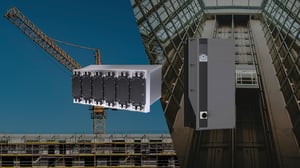
The variable frequency drive is one of the most important components in industrial electrification. It is also one of the most thermally stressed.
A typical industrial VFD, the kind controlling a megawatt-scale pump, compressor, or conveyor in a manufacturing plant or energy facility, converts grid power to variable-frequency output using banks of IGBT power modules. These modules are the thermal heart of the system. Under real-world load, they concentrate hundreds of watts of switching and conduction losses into a small area, mounted on a shared heatsink inside a sealed, standardized cabinet. The cabinet geometry does not change. The heatsink footprint does not change. But as drive power ratings climb and next-generation SiC modules push heat flux density higher, the thermal headroom inside that cabinet is shrinking.
Traditional skived aluminium heatsinks hit a hard spreading limit, creating unavoidable hotspots directly above the modules. Embedded heat pipe solutions offer partial relief, but carry a serious long-term risk: at high heat flux, heat pipes can experience dry-out, a sudden collapse in thermal performance that is impossible to recover from in the field. Drive designers are stuck between a thermal ceiling they cannot raise and a liquid cooling system they cannot afford to add.
NEOcore removes the ceiling.
CooliBlade's NEOcore is an integrated 3D thermosyphon built as a 100% aluminium structure. Power modules mount directly onto the integrated aluminium evaporator base, where heat vaporises the working fluid and drives it naturally to the condenser fins; no pumps, no wicks, no moving parts. Because the entire structure is aluminium, heat spreads uniformly across the full fin stack with zero interface losses.
In a direct retrofit of a narrow air-channel VFD, cooling a highly concentrated 3 kW thermal load (three 1 400 W SiC modules and three 300 W bridge modules) within the exact same cabinet footprint, CooliBlade's AURORA platform reduced the critical IGBT module temperature by 18.8 K. Because thermal rise scales linearly with power, this 18.8 K drop means the drive can safely dissipate 23 % more heat before reaching its original temperature limit, effectively unlocking a 20% increase in the drive's power rating.
In a compact redesign using the ULTIMA platform handling a 3 kW thermal load (three 700 W SiC modules and three 300 W rectifier modules), the heatsink face area shrank by 26%, pressure loss dropped from 340 Pa to 200 Pa, and module temperatures still fell by 11.5 K. Both results were achieved with zero liquid cooling.
What 18.8 degrees actually buys you.
You can spend that new thermal headroom in three ways.
First is reliability: the Arrhenius equation dictates that every 10°C reduction in junction temperature roughly doubles component lifetime. An 18.8 K improvement nearly triples the operational life of the IGBTs, turning a standard drive into an ultra-reliable platform for harsh environments.
Second is power density: as calculated above, you can push 20% more power through the exact same machine without derating. You can push significantly higher heat loads through the exact same cabinet footprint. Near peak load, an 18.8 K hotspot reduction can unlock up to 280 kW of additional production capacity for a 1 MW-class inverter.
Third is cost reduction: with vastly improved thermal spreading, you can redesign the drive with fewer parallel IGBT or SiC modules to achieve the same original power rating. That lowers the bill of materials and simplifies the assembly of the drives.
As SiC scales, this advantage compounds.
The transition to silicon carbide is accelerating across the VFD industry. SiC modules switch faster, run hotter, and concentrate losses into smaller die areas than their silicon IGBT predecessors, making the thermal management problem significantly harder. Heat pipe solutions, already marginal at high silicon heat flux, face a genuinely hostile operating environment with SiC. NEOcore's fully aluminium thermosyphon architecture has no wick to saturate, no interface layer to degrade, and no dry-out mechanism to trigger. The result is that the performance gap between NEOcore and conventional solutions does not stay constant as power density rises, it widens. The harder the thermal problem becomes, the more decisively the 3D two-phase cooling wins.
The measured data is in the application note.
Everything described here is backed by physical test results. Full ΔT comparisons, heatsink dimensions, pressure loss curves, and component lifetime projections across both the AURORA and ULTIMA platforms. If you are designing or re-engineering a VFD platform and thermal headroom is a constraint, the application note gives you the engineering basis to make the case internally for a different approach. Download it from the form below