

CooliBlade ULTIMA-XPassive thermosyphon heat sink for M1-type IGBT and SiC modules
ULTIMA-X is an all-aluminium, passive two-phase heat sink for two M1-type power modules in a wide air duct. Heat from the modules boils a sealed working fluid at the baseplate, the vapour carries it up through aluminium pipes into the fins, and the condensate runs back down by gravity, with no pump and no moving parts.
A ready-to-test reference. Mount your own modules and measure it in your own setup.
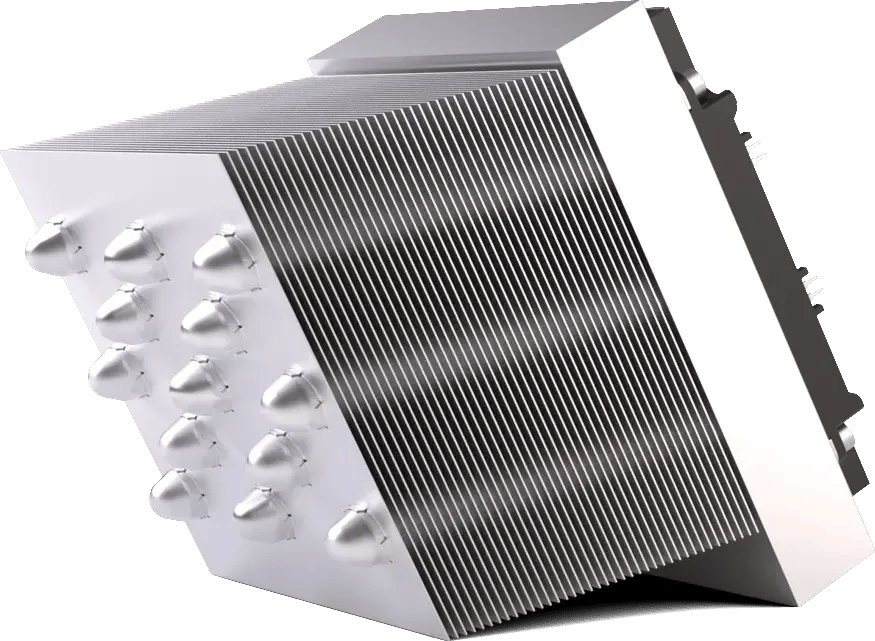
Fits M1-type packages from all major module manufacturers, two per heat sink. Where it fits
Using one of these modules?
ULTIMA-X takes them as is: two modules per heat sink, no adapters. IGBT or SiC.
Not on the list? Send us the module data sheet. We check the fit as part of a free feasibility evaluation.
Check my moduleCooler at the modules
19K
lower module baseplate temperature at 1 000 W per module than a skived aluminium heat sink of the same form factor.
[Measured. ULTIMAX-V02-M1-2-180-X01, 2 × M1, 180 mm condenser, 200 m³/h per module (400 m³/h through the heat sink), temperature at the module copper baseplate. 45.0 against 64.4 K rise.]
See the full curveMore power per module
+40%
more power per module at the same temperature rise. Or keep the power and take the kelvins as margin.
[Measured. ULTIMA-X reaches the reference's 64.4 K rise at about 1 400 W per module; the skived aluminium heat sink reaches it at 1 000 W. Same form factor, 200 m³/h per module, module copper baseplate.]
Run your own load caseSiC makes the heat sink the limit
Silicon carbide lets inverters and drives switch faster and push more power through the same module packages. The losses now sit in much smaller chips, so heat flux at the baseplate goes up. A solid aluminium heat sink spreads that heat by conduction alone, and taller fins add little when the aluminium cannot carry the heat up to them.
So the heat sink, not the module, decides how much of the rating you can use. Every kelvin you take off the baseplate is margin for more current, a hotter ambient or a longer service life.
How it works
Three parts.
All aluminium.
The NEOcore channel starts in the baseplate under the modules, runs up through the pipes, and the fins act as the condenser. The heat reaches the whole fin stack instead of stalling near the baseplate.
- 1BaseplateModules mount here. The working fluid boils in the shared evaporator underneath them, which feeds every pipe.
- 2PipesVapour rises along the top of the pipes. The condensate drains back along the bottom.
- 3FinsThe fins act as the condenser, and the air carries the heat away.
Illustrative, not simulated. Base plate shown transparent: heat from the power modules boils the acetone in the shared evaporator, the vapour rises through the condenser pipes into the fin stack, and the condensate drains back along the bottom of the pipes. Speeds and bubble counts are illustrative. Example module layout.
How NEOcore worksHow much cooler, and how much more power
Measured on our own test bench against a skived aluminium heat sink of the same form factor, without NEOcore.
[Measured. ULTIMAX-V02-M1-2-180-X01, 2 × M1, 180 mm condenser, 400 m³/h through the heat sink (200 m³/h per module), temperature at the module copper baseplate. Reference: skived aluminium heat sink, same form factor. ULTIMA-X brochure Rev 01, 09/2026.]
Module baseplate temperature rise above ambient
Module baseplate temperature rise above ambient [K]
| Power per module [W] | 302 | 401 | 500 | 600 | 700 | 800 | 900 | 1 000 | 1 100 | 1 200 | 1 300 | 1 400 | 1 450 |
|---|---|---|---|---|---|---|---|---|---|---|---|---|---|
| ULTIMA-X | 14.6 | 18.8 | 23.0 | 27.3 | 31.7 | 36.1 | 40.4 | 45.0 | 49.6 | 54.3 | 58.7 | 63.8 | 66.2 |
| Skived aluminium | 19.4 | 25.8 | 32.2 | 38.6 | 45.1 | 51.5 | 58.0 | 64.4 | 70.8 | 77.3 | 83.7 | 90.2 | 93.4 |
[Measured. Values of the chart above: module copper baseplate, 200 m³/h per power module (400 m³/h through the heat sink). ULTIMA-X brochure Rev 01, 09/2026.]
How ULTIMA-X solves it in your application
Moving to SiC inside an existing frame size, with no room to grow the heat sink.
Same modules, same mounting
M1-type modules mount as is, two per heat sink, no adapters. IGBT today, SiC tomorrow.
Kelvins become margin
19 K lower module baseplate temperature at 1 000 W per module, against a skived aluminium heat sink of the same form factor.
[Measured. 2 × M1, 200 m³/h per module, module copper baseplate]
Height becomes cooling
Where the frame leaves height in the duct, ULTIMA-X turns it into cooling. Condenser length and fin layout adapt to the space.
The power conversion stage holds many modules side by side, and with liquid cooling, every module adds plumbing to maintain. We cool the converter, not the cells.
Air instead of a coolant loop
Passive two-phase cooling on air. No pumps, no coolant to connect and nothing to leak, however many modules the converter has.
Scales by assembly
Several heat sinks combine side by side into one assembly of the required width.
Every unit tested
Each heat sink passes a performance test bench at the end of our production line, so unit fifty behaves like unit one.
Charger power stages push high losses through compact modules, often in cabinets far from a service technician.
Nothing to service on site
The channel is sealed and passive. No pump, no coolant and no moving parts to visit in the field.
Height becomes cooling
NEOcore carries the heat into the whole fin stack, so a taller air interface moves more heat.
Every unit tested
Each heat sink passes a performance test bench at the end of our production line before it ships.
Power conversion that runs around the clock, where every pump and coolant loop adds one more thing that can fail.
No liquid near the electronics
Passive two-phase cooling on air. No coolant to connect and nothing to leak.
No moving parts
The only thing that moves inside ULTIMA-X is the sealed working fluid.
Height becomes cooling
Where the rack leaves height in the air path, ULTIMA-X turns it into cooling.
High losses per module position, and the aluminium heat sink is already at its limit. Inverters often sit outdoors, far from service.
Height becomes cooling
NEOcore carries the heat into the whole fin stack, so a taller air interface moves more heat instead of adding dead aluminium.
Nothing to service in the field
The channel is sealed and passive. No pump, no coolant, no moving parts to visit on site.
Built for the climate
Rated for ambient temperatures from −50 °C to +60 °C.
[Data sheet Rev 01]
Power stages that have to work the moment they are called on, with as little maintenance as possible in between.
Nothing to maintain
No pump, no coolant and no moving parts in the cooling path.
Wide temperature window
Rated for ambient temperatures from −50 °C to +60 °C.
[Data sheet Rev 01]
Every unit tested
Each heat sink passes a performance test bench before it ships.
Narrow or height-limited duct? CooliBlade AURORA-X builds the NEOcore channel into a conventional heat sink form factor. See AURORA-X
What you get
Fits your modules.
Nothing to service.
ULTIMA-X specification
| Product code | ULTIMAX-V02-M1-2-180-X01 |
| Installation | Vertical |
| Power modules | 2 × M1 package, from all major module manufacturers |
| Semiconductor | IGBT or SiC |
| Condenser length | 180 mm |
| Main dimensions (X1 × Y × Z) | 170 × 140 × 193 mm |
| Weight | 3 850 g |
| Thermal resistance | 45 to 48 K/kW, 300 W to 1 450 W per module [Measured, 200 m³/h per module, module copper baseplate to ambient] |
| Airflow (test condition) | 200 m³/h per module |
| Pressure drop | To be confirmed |
| Material / working fluid | Aluminium / acetone |
| Ambient temperature | −50 °C to +60 °C |
| Max. internal temperature | 150 °C |
| Compliance | RoHS, REACH |
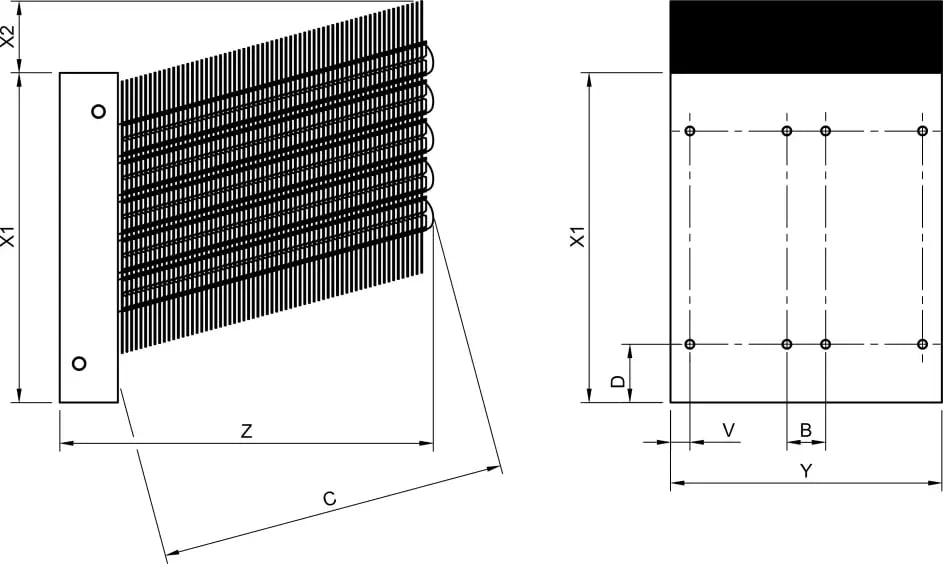
X1 170 · X2 37 · Y 140 · Z 193 · C 180 · D 30 · V 10 · B 20 mm. Detailed drawings and installation angles in the data sheet.
Evaluate, adapt, scale
Evaluate
Start with the reference heat sink. Mount your modules and measure it in your own setup.
Adapt
Condenser length, fin layout, number of modules, orientation and mounting adapt to your design. Send your module layout and enclosure geometry as they are; we shape the evaporator to fit them.
Scale
Move to series production of your own version, built and tested in Finland.
Designed, prototyped and assembled in-house in Finland. ISO 9001 certified quality management.
We start from your modules, your air duct and your enclosure. If passive cooling will not close the gap, we say so.
ULTIMA-X questions engineers ask
Which power modules does ULTIMA-X fit?
M1-type packages from all major module manufacturers, two modules per heat sink, with no adapters. IGBT or SiC.
Does ULTIMA-X need a pump or maintenance?
No. The thermal channel is sealed and passive, with no pump, no coolant to connect and no moving parts.
What airflow was ULTIMA-X measured at?
200 m³/h per module, 400 m³/h through the heat sink, with temperature taken at the module copper baseplate.
How is ULTIMA-X different from AURORA-X?
ULTIMA-X is for wide air ducts: pipes carry the NEOcore channel up into tall fins. AURORA-X is for narrow or height-limited ducts: the channel sits inside a conventional heat sink form factor.
Check it against your design
Test ULTIMA-X with your own modules
Tell us your module type, thermal power per module, ambient temperature and airflow. If the reference fits, we send an evaluation kit. If your case needs a different condenser length or layout, you get a free feasibility evaluation instead, with every result marked measured or simulated. No obligation.